
InnovexLab UTI panel
Bacterial, atypical and yeast uropathogens identified directly from the specimen, with a reflex antibiotic-resistance gene panel. Validated for swab collection, so specimens can be collected without catheterization, including from incontinent and older residents.
General medical information for education only, not medical advice. Targets as listed on InnovexLab’s requisition forms (general requisition form). Detection of a target does not by itself establish infection or determine treatment; results are interpreted by the ordering clinician with the clinical picture and, where indicated, culture and susceptibility testing.
When to consider testing
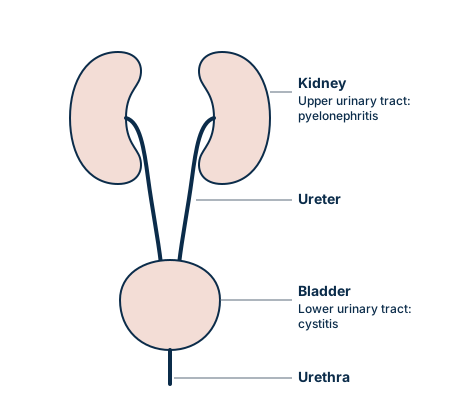
Symptomatic patients with a suspected urinary source: dysuria, frequency, urgency, suprapubic or flank pain, or fever without another source. Asymptomatic bacteriuria should not be tested or treated outside specific situations such as pregnancy.
Interpretation
Detection does not by itself establish infection; colonization and contamination are possible, especially with catheters. Confirm susceptibility where indicated.
Targets (36)
Select a target for its clinical summary, symptoms, resistance and treatment considerations.
Gram-negative bacteria (13)
- Escherichia coliA normal inhabitant of the human gut and the most common cause of urinary tract infection.
- Klebsiella pneumoniaeAn encapsulated gut organism and a major cause of healthcare-associated infection, frequently carrying resistance genes.
- Klebsiella oxytocaA Klebsiella species found in the gut and the healthcare environment.
- Klebsiella aerogenesA healthcare-associated Gram-negative rod, often in catheterized or ventilated patients.
- Enterobacter cloacaeGram-negative rods common in healthcare settings, notable for inducible AmpC beta-lactamase.
- Citrobacter freundiiA gut and environmental Gram-negative rod causing opportunistic infection.
- Serratia marcescensAn environmental Gram-negative rod associated with healthcare outbreaks, catheters and contaminated solutions.
- Proteus mirabilisMotile, urease-producing Gram-negative rods.
- Proteus vulgarisMotile, urease-producing Gram-negative rods.
- Morganella morganiiA urease-producing Gram-negative rod causing opportunistic and healthcare-associated infection.
- Providencia stuartiiA Gram-negative rod strongly associated with long-term urinary catheters in older adults.
- Pseudomonas aeruginosaA non-fermenting Gram-negative rod thriving in moist environments; a major healthcare-associated pathogen.
- Acinetobacter baumanniiA Gram-negative coccobacillus that survives on dry surfaces and causes healthcare-associated outbreaks.
Gram-positive bacteria (6)
- Enterococcus faecalisA Gram-positive coccus in pairs and short chains from the gut; hardy in the healthcare environment.
- Enterococcus faeciumA gut enterococcus and the species most often resistant to vancomycin (VRE).
- Staphylococcus aureusA Gram-positive coccus in clusters carried on the skin and in the nose of many people, and a major cause of skin, soft-tissue and invasive infection.
- Staphylococcus saprophyticusA coagulase-negative staphylococcus and a common cause of cystitis in young, sexually active women.
- Streptococcus agalactiae (group B)A Gram-positive coccus that colonizes the gut and genital tract.
- Streptococcus pneumoniaeA Gram-positive lancet-shaped diplococcus colonizing the nasopharynx and the most common bacterial cause of community-acquired pneumonia.
Atypical bacteria (2)
- Mycoplasma hominisA genitourinary bacterium without a cell wall that often colonizes without causing disease.
- Ureaplasma urealyticumGenitourinary bacteria without a cell wall that commonly colonize the urogenital tract.
Yeasts (7)
- Candida albicansThe most common Candida yeast, part of normal oral, gut and vaginal flora.
- Candida aurisAn emerging, often multidrug-resistant yeast that spreads in healthcare facilities, particularly long-term and ventilator care.
- Candida glabrataNon-albicans Candida species, increasingly common in vaginal, urinary and invasive infection, with species-specific antifungal patterns.
- Candida kruseiNon-albicans Candida species, increasingly common in vaginal, urinary and invasive infection, with species-specific antifungal patterns.
- Candida lusitaniaeNon-albicans Candida species, increasingly common in vaginal, urinary and invasive infection, with species-specific antifungal patterns.
- Candida parapsilosisNon-albicans Candida species, increasingly common in vaginal, urinary and invasive infection, with species-specific antifungal patterns.
- Candida tropicalisNon-albicans Candida species, increasingly common in vaginal, urinary and invasive infection, with species-specific antifungal patterns.
Reflex antibiotic-resistance genes (8)
- AmpC
- mecA, femA
- qnrA, qnrB
- vanA1, vanA2, vanB
- NDM, KPC, OXA-48, VIM, IMP-7
- SHV, TEM, CTX-M1, CTX-M2
- ermA, ermB
- mefA
Sources
- IDSA. Complicated Urinary Tract Infections guideline.
- IDSA. Asymptomatic Bacteriuria guideline.
- IDSA. Guidance on the Treatment of Antimicrobial-Resistant Gram-Negative Infections.
- CDC. ESBL-producing Enterobacterales.
- CDC. Carbapenem-resistant Enterobacterales (CRE).
Sources accessed November 2026. Links open external sites that InnovexLab does not control.
Medical disclaimer
This page is general educational information summarized from published public-health and professional-society guidance. It is not medical advice, a diagnosis or a treatment recommendation, and reading it does not create a clinician–patient relationship with InnovexLab. Decisions about testing, diagnosis and treatment belong to the treating clinician, using the patient’s history and examination, laboratory and susceptibility results, local resistance patterns and current guidelines. Guidance changes over time; consult the original sources for the latest version. InnovexLab provides this information as is and does not warrant that it is complete or current.
Patients with questions about their health should contact their own healthcare provider. In an emergency, call 911.